
Every business has a customer journey, even if it has never been formally mapped. A person sees an ad, visits a website, reads reviews, compares options, sends a request, speaks with a manager, receives a service, contacts support, and decides whether to return.
For the company, these steps may seem separate. Marketing handles the first contact, sales handles the inquiry, operations deliver the service, and support solves problems. But for the customer, it is one continuous experience.
Customer journey mapping helps businesses see that experience clearly. It shows how customers move through each stage, where they feel confident, where they become confused, and where the company may lose trust, leads, or repeat sales.
For growing businesses, this is especially important. As a company becomes larger, customer interactions often become more complex. Without a clear journey map, small problems can turn into repeated friction.
What Is Customer Journey Mapping?
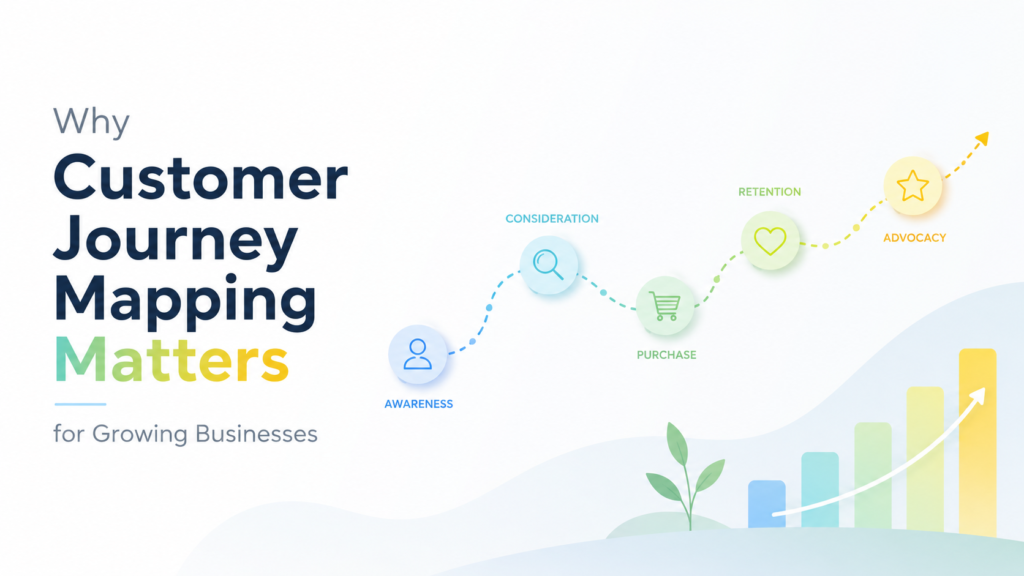
Customer journey mapping is the process of visualizing how a customer interacts with a business from the first point of awareness to long-term loyalty.
A journey map usually includes the main stages of the customer experience, such as discovery, research, decision-making, purchase, onboarding, service delivery, support, and repeat engagement. For each stage, the company can identify customer goals, questions, emotions, touchpoints, and possible problems.
The purpose is not only to create a nice diagram. The real purpose is to understand what the customer experiences and what the business should improve.
For example, a customer may find your website through search, but leave because the service description is unclear. Another customer may send a request, but become frustrated because the response takes too long. A third customer may complete a purchase, but never return because there is no follow-up communication.
A journey map helps reveal these moments.
Why Businesses Lose Customers Without Noticing
Many customer experience problems are not obvious from inside the company. A team may believe that everything works well because each department completes its own task. The website is online, the contact form works, the sales team replies, and the service is delivered.
But the customer may still experience the process differently.
They may not understand which service fits their situation. They may not know what happens after submitting a form. They may receive too many emails or not enough information. They may feel that pricing is unclear. They may have to repeat the same details several times to different people.
These problems may seem small, but together they create friction. And friction reduces trust.
Customer journey mapping helps businesses find these weak points before they become larger issues. It connects separate interactions into one full picture.
How Journey Mapping Improves Customer Experience
A good journey map helps a business make the customer experience easier, clearer, and more consistent.
First, it shows where customers need more information. If people hesitate before contacting the company, the website may need stronger explanations, clearer pricing guidance, better FAQs, or more visible proof of trust.
Second, it reveals communication gaps. If customers are unsure what happens after booking, requesting a quote, or making a purchase, the company can improve confirmation messages, follow-up emails, and onboarding steps.
Third, it helps teams understand responsibility. When several departments touch the same customer journey, a map shows where handoffs happen and where customers may feel lost.
Fourth, it helps prioritize improvements. Instead of changing everything at once, the business can focus on the stages that create the most confusion, complaints, or lost opportunities.
The Main Stages of a Customer Journey
Although every business is different, many customer journeys include several common stages.
Awareness
This is when a potential customer first discovers the business. It may happen through search, social media, referral, advertising, review platforms, or local visibility.
At this stage, the customer asks: “Is this relevant to me?”
Consideration
The customer compares options, reads service pages, reviews pricing signals, studies testimonials, and tries to understand whether the business can solve the problem.
At this stage, the customer asks: “Can I trust this company?”
Decision
The customer decides whether to contact, book, buy, request a quote, or choose another provider.
At this stage, the customer asks: “Is it easy and safe to take the next step?”
Onboarding
After the first action, the customer expects clear communication. They want to know what happens next, what information is needed, how long the process takes, and who is responsible.
At this stage, the customer asks: “Did I make the right choice?”
Service Delivery
This is where the company provides the actual service or product. The customer evaluates quality, communication, reliability, timing, and the overall experience.
At this stage, the customer asks: “Is this meeting my expectations?”
Support and Follow-Up
After the main service is delivered, the customer may need help, clarification, maintenance, or additional information.
At this stage, the customer asks: “Will this company stay helpful after the sale?”
Loyalty
A satisfied customer may return, recommend the company, leave a positive review, or become a long-term client.
At this stage, the customer asks: “Would I use this company again?”
Where Customer Feedback Fits In
A journey map should not be built only from internal opinions. Teams can describe how they think the process works, but customers can explain how it actually feels.
That is why feedback is an important part of journey mapping. Surveys, interviews, website feedback forms, support comments, reviews, and post-service questionnaires help confirm where the real friction points are.
For example, a company may think that customers leave because the price is too high. Feedback may show that customers actually leave because they do not understand what is included. Another company may think that support is the problem, while customers are more frustrated with unclear onboarding.
Customer feedback makes the journey map more accurate. It helps the business avoid solving the wrong problem.
How to Start Mapping Your Customer Journey
A business can start with a simple version of a customer journey map.
First, list the main stages customers go through: discovery, website visit, inquiry, consultation, purchase, onboarding, service delivery, support, and repeat contact.
Second, identify the touchpoints at each stage. These may include ads, website pages, contact forms, emails, phone calls, invoices, proposals, support messages, and follow-up surveys.
Third, write down what the customer is likely trying to do at each stage. Are they comparing prices? Looking for proof? Trying to understand the process? Waiting for confirmation?
Fourth, look for friction. Where do people hesitate? Where do they ask the same questions repeatedly? Where do leads disappear? Where do complaints happen?
Fifth, collect feedback to check your assumptions. Even a short survey can help show whether your internal view matches the customer’s experience.
Finally, choose the first improvements. Do not try to fix the entire journey at once. Start with the touchpoints that affect trust, conversion, satisfaction, or retention most directly.
Common Mistakes in Customer Journey Mapping
One common mistake is making the map too complicated. A journey map should help people understand the experience, not confuse them with unnecessary detail.
Another mistake is focusing only on the sales process. The customer journey does not end after payment. Onboarding, delivery, support, and follow-up often have a stronger effect on loyalty than the first sale.
A third mistake is ignoring emotional moments. Customers do not only evaluate facts. They also feel uncertainty, confidence, frustration, relief, or trust. These emotions influence decisions.
The biggest mistake is creating a journey map and then doing nothing with it. A map should lead to action: clearer pages, better forms, improved emails, stronger support, simpler onboarding, or better follow-up.
Conclusion
Customer journey mapping helps businesses understand the full experience customers have with their brand. It shows where people discover the company, what they need before making a decision, where friction appears, and how the business can improve each stage.
For growing companies, this is not just a design exercise. It is a practical way to improve conversion, satisfaction, retention, and trust.
When a business sees the journey through the customer’s eyes, it becomes easier to build experiences that feel clear, reliable, and worth returning to.